GRASP
A training-free LLM system that learns from each session to make FPS games clearer, gentler, and easier for older adults to play. (Game Society and Culture Project)
To read the full report: (Report PDF: Click here)
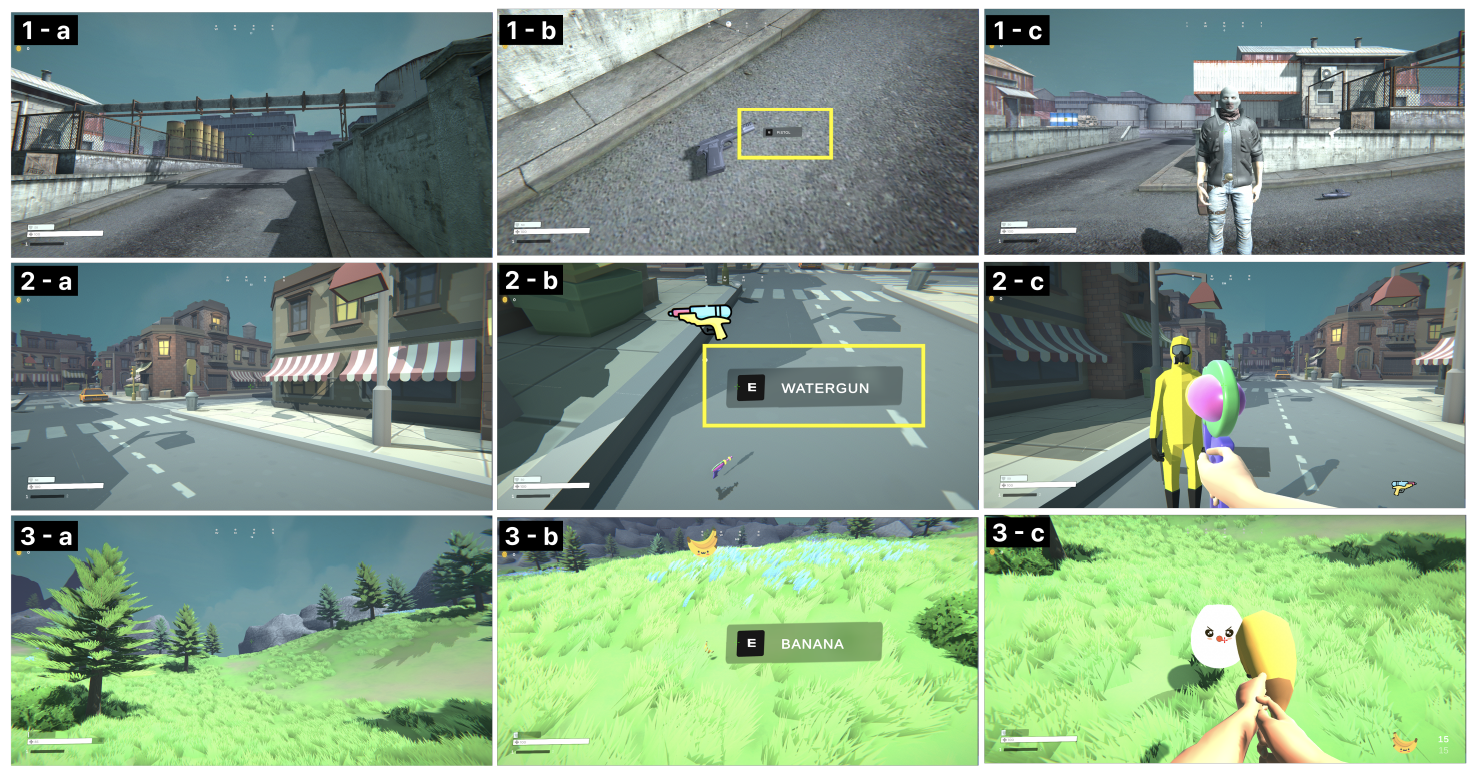
This project explores how to make first-person shooter (FPS) games more accessible for older adults in a context where collecting large gameplay datasets is difficult and ethically sensitive. Instead of relying on training data or behavioral modeling, we developed a training-free adaptation system that adjusts game elements—such as UI scale, enemy difficulty, weapon appearance, and thematic tone—based on the needs of older adult players. Because older adults are underrepresented in gaming and often face barriers such as unfamiliar controls, discomfort with violent content, or visually dense interfaces, designing effective adaptations typically lacks actionable data. Our goal is to investigate whether a reasoning-driven system like Reflexion can help bridge this gap by providing scalable, explainable, and personalized accessibility adjustments without requiring any pre-collected dataset.
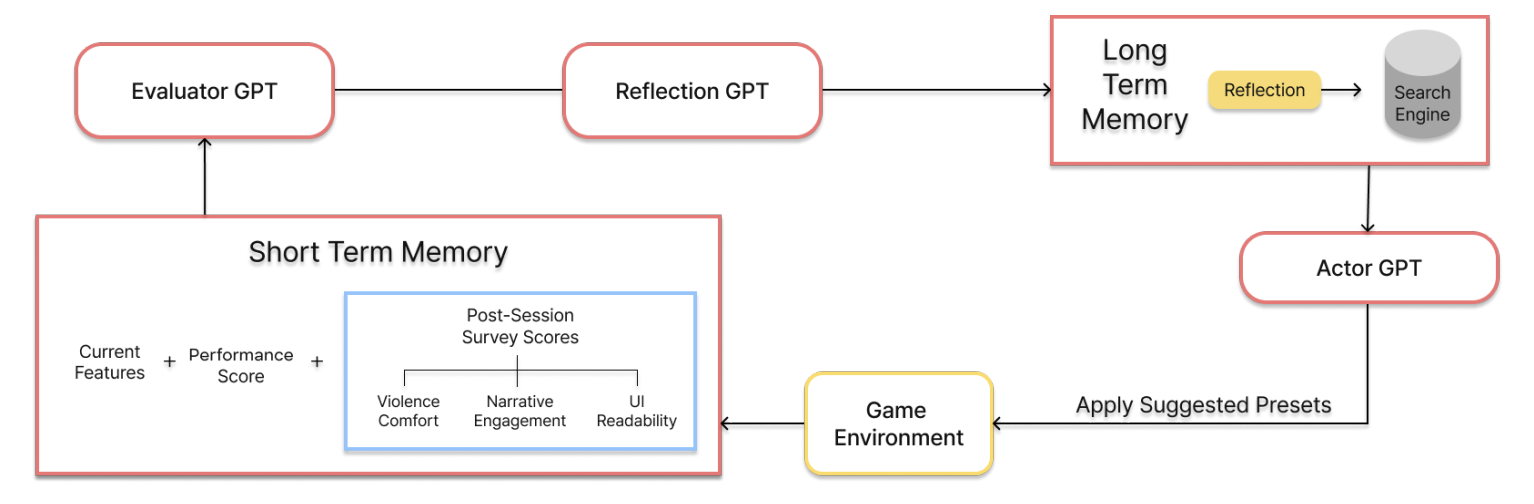
Our system adapts the Reflexion architecture into a multi-agent workflow consisting of Evaluator GPT, Reflection GPT, and Actor GPT, each operating between gameplay sessions. After each session, Evaluator GPT analyzes objective performance signals and subjective feedback (e.g., violence comfort, UI readability, narrative engagement) to determine whether the previous configuration succeeded. When needed, Reflection GPT generates design insights using failure patterns and memory of past sessions. Actor GPT then retrieves similar historical cases using FAISS and synthesizes a new “preset string” that encodes modular accessibility changes—such as difficulty (enemy health), UI size, weapon theming, aim-assist settings, and narrative style—which are mapped directly to Unity prefabs to create the next session’s game environment. This Reflexion loop allows the system to iteratively refine gameplay for older adults while remaining interpretable and fully training-free.